
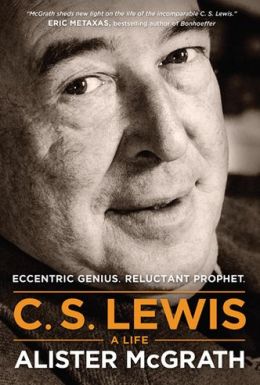
 Alister McGrath, who has two Oxford PhDs – one in molecular biophysics and the other in theology – and who has written, debated, lead, etc. at the highest levels – has two new books out on C.S. Lewis. One is on Lewis’s intellectual thought and the other is on his life. I attended a lecture McGrath gave tonight at a local bookstore. There were about 30 of us there. He spoke mostly from a biography, C.S. Lewis – A Life: Eccentric Genius & Reluctant Prophet. Here is a brief summary, following the format McGrath used in the lecture: he asked himself questions and then answered them. (Note: I am condensing down 60 minutes of material into a quick read).
Why another bio on C.S. Lewis? Because it’s the 50th anniversary of his death, there is a surprising amount of stuff we still do not know, and because the recent release (2006) of all of Lewis’s correspondence made it possible for me to learn some new things.
Why should you write a biography? I did not know Lewis personally, but I am in a unique position to understand him. We both were born in Belfast (Northern Ireland), attended Oxford as outsiders, showed up as atheists, came to faith while at Oxford and ended up joining the faculty.
What did you learn that is new? Several things. First, I argue that in Surprised by Joy, Lewis reports the date of his conversion wrong. Second, I believe we now have a greater understanding of how his relationship with Tolkien deteriorated. 3) I learned that he nominated Tolkien for a Pulitzer Prize in Literature, and finally, I learned how hard some periods of his life were – World War I, the years he was caring for Mrs. Moore and his alcoholic brother, etc.
Why did Lewis become a Christian? It wasn’t that there was 65 arguments for believing in God. It was that Christianity provided a visual way of seeing things. Lewis saw things. He didn’t hear them. He saw them in his mind, consequently he was always after a better lens through which to understand the world. He came to the conclusion that the Christian faith was that lens – it made the best sense of rational life and imagination.
Why are we still reading Lewis 50 years after his death? Lewis believed he would be forgotten five years after his death. In the 1960s – 1970s it looked like he was right. Then he bounced back. We are not entirely sure why. The bounce mainly happened in the US, where he is taken much more seriously than in England. It happened primarily because of American evangelicals but also among American Catholics. It’s odd that RC gravitate to Lewis b/c he was an Ulster Protestant, who carried a bit of that edge with him up until close to the end. But his friendship with Tolkien and his strong endorsement of G.K. Chesterton paved the way for RC interest. It made him safe.
Closing Thoughts: 1) Lewis was not a saint. He was a flawed and fallen human being, just like we all are. 2) He said some important things, but one of the key things is that he said them so well. (His early – and failed – efforts to become a poet left him with a great sense of cadence and very colorful prose.) 3) In Mere Christianity he presents the tri-lemma in a much edited – and weaker – way than he does in the original broadcast; 4) When you start pressing Lewis – as serious scholars are now starting to do – you find that there is a lot more there than most people realized; 5) Lewis is one of the very few apologists who appeals to both modernists (rational) and postmodern readers. No other apologist does this as well.